
Why Stepper Motors Are the Standard in 3D Printing
Every FDM 3D printer on the market — from a $200 Ender-3 to a $50,000 industrial machine — relies on stepper motors to position the print head, move the bed, and push filament through the hot end. Steppers won this role because they provide precise, repeatable motion from simple digital signals without needing encoders or complex tuning. A four-wire motor, a driver chip, and a microcontroller: that is all you need.
But not all stepper motors perform equally in a 3D printer. The wrong motor can cause layer shifting, under-extrusion, ghosting artifacts, and excessive noise. The right motor, matched to its specific role in the printer, delivers cleaner prints, faster speeds, and longer machine life.
This guide covers motor selection for each function in a 3D printer, from entry-level desktop builds to large-format industrial systems.
Motor Requirements by Printer Axis
X and Y Axes: Speed and Smoothness
The X and Y axes determine print speed and surface quality. These axes accelerate and decelerate rapidly during direction changes, so low rotor inertia is important for sharp corners. On belt-driven printers (the standard for X/Y), a NEMA 17 motor (42 mm frame) with 0.4–0.5 N·m holding torque is the standard choice. Body length of 40–48 mm provides the right balance of torque and weight.
For CoreXY kinematics, both X/Y motors run simultaneously during every move. Use identical motors on both positions to ensure balanced performance. A mismatched motor pair will cause dimensional errors on diagonal moves.
If you are building a high-speed printer targeting 300+ mm/s print speeds, look for low-inductance NEMA 17 motors (under 3 mH) paired with 24V or 36V drivers. Low inductance allows faster current buildup, which translates directly to better torque at high step rates.
Z Axis: Holding Force and Stability
The Z axis moves slowly (typical layer heights are 0.1–0.3 mm, so Z moves are very short) and must hold position reliably between layers. A NEMA 17 motor with 0.4 N·m is adequate for lead-screw-driven Z axes on standard bed-slingers. For machines with dual Z screws (increasingly common), two smaller motors (0.3 N·m each) provide redundancy and bed leveling capability.
On large-format printers where the bed or gantry is heavy, a NEMA 23 motor on the Z axis provides the holding torque needed to prevent Z-axis sag during fast travel moves. The extra cost of a NEMA 23 is justified if Z accuracy is critical for your print quality.
Extruder: Torque for Filament Feeding
The extruder motor pushes filament through the hot end and is the most torque-demanding motor relative to its size. It must maintain consistent filament pressure against the resistance of the melting zone. Under-extrusion, clicking, and skipped steps at the extruder are almost always caused by insufficient motor torque or improper driver current settings.
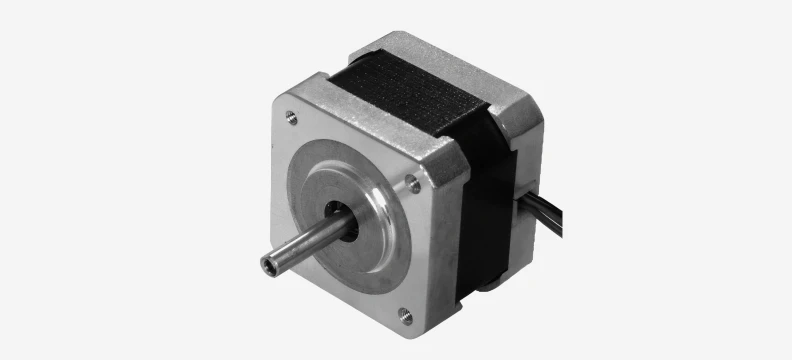
For direct-drive extruders, a compact NEMA 17 (42BYG, ~34 mm body, 0.2–0.4 N·m) minimizes carriage weight while providing enough grip on the filament. A pancake motor (20–24 mm body) saves weight but may not have enough torque for high-flow printing or flexible filaments.
For Bowden setups, the extruder motor is not on the moving carriage, so weight is not a constraint. Use a full-size NEMA 17 (48 mm body, 0.5 N·m) for maximum filament grip and reliability.
NEMA 17 vs. NEMA 23 for 3D Printers
| Factor | NEMA 17 (42mm) | NEMA 23 (57mm) |
| Holding Torque Range | 0.1–0.6 N·m | 0.5–3.0 N·m |
| Weight | 150–400 g | 500–1800 g |
| Best For | Standard desktop printers | Large-format, heavy-bed printers |
| Typical Frame Cost | Lower | ~30–50% more |
| Standard In | Ender, Prusa, Voron (X/Y/E) | Voron 350+ Z, industrial FDM |
| Speed Performance | Good to 200–300 mm/s | Better at high loads/low speeds |
For most desktop 3D printers (build volume under 300 mm³), NEMA 17 motors are the correct choice for all axes. NEMA 23 enters the picture when the build volume exceeds 400–500 mm in any dimension, when the bed or gantry mass exceeds 3–4 kg, or when the Z axis uses long, heavy lead screws.
Common Print Quality Issues Traced to Motor Problems
Layer shifting: the most obvious stepper motor failure mode. Happens when the motor loses steps during a rapid move. Causes include insufficient driver current, excessive print speed, binding on an axis, or a motor that is simply too weak for the load. Fix: increase driver current (within the motor’s rated spec), reduce acceleration, check for mechanical binding, or upgrade to a higher-torque motor.
Ghosting / ringing: ripples in the print surface after sharp corners. This is resonance — the motor overshoots the target position and oscillates. Fix: reduce acceleration and jerk settings in firmware, add input shaping (if your firmware supports it), or switch to a driver with better microstepping (TMC2209 or TMC5160). The motor itself contributes through its rotor inertia; lower inertia = less ringing.
Under-extrusion: the extruder motor cannot push filament fast enough. Causes include a too-small motor, incorrect driver current, heat creep in the hot end, or a clogged nozzle. First rule out mechanical causes, then check that the driver is set to the motor’s rated current.
Motor noise: the characteristic stepper buzz. Significantly reduced by using TMC-series drivers in StealthChop mode. Also reduced by running the driver at 24V or higher supply voltage instead of 12V. If noise is a priority, consider specifying motors with 0.9° step angle (400 steps/rev) which are inherently smoother than 1.8° motors.
When to Upgrade to Closed-Loop Motors
Most 3D printers run open-loop steppers without issues. Closed-loop upgrades are justified in specific scenarios:
Long prints on expensive materials. A 36-hour print in carbon-fiber PETG that fails on hour 30 due to a missed step wastes significant material and time. Closed-loop detection catches the error immediately, allowing the printer to pause or alert the operator.
Production print farms. When running 10+ printers 24/7, the cumulative cost of failed prints from occasional step losses adds up. Closed-loop motors on the X/Y axes are a small investment relative to the value of prevented failures.
Heavy direct-drive carriages. A direct-drive extruder with a heavy hotend assembly (Mosquito, Dragon, etc.) adds significant mass to the X carriage. During rapid direction changes, the inertia can cause step loss on fast-printing profiles. Closed-loop correction keeps up even when the open-loop margin is thin.
Cymotorix Motors for 3D Printing
Our NEMA 17 (42BYG) line covers the full range of 3D printer needs, from 20 mm pancake motors for lightweight direct-drive extruders to 60 mm high-torque units for heavy Z axes. Our NEMA 23 (57BYG250) series serves large-format and industrial 3D printers. Both are available in open-loop and closed-loop configurations.
For 3D printer OEMs, we offer custom winding specifications (optimized for 12V, 24V, or 36V systems), custom shaft lengths, and connector-terminated leads for plug-and-play integration. Minimum order quantities are flexible for prototype runs.
Get in touch to discuss your printer’s motion system requirements. We’ll recommend the right motor for each axis within 24 hours.
Frequently Asked Questions
What stepper motor is best for a 3D printer?
For standard desktop FDM printers, a NEMA 17 motor with 0.4–0.5 N·m holding torque and 40–48 mm body length is the standard. For extruders, a shorter 34 mm body is common to save weight. For large-format printers with heavy beds or gantries, NEMA 23 motors provide the additional torque needed on the Z axis.
Can I use NEMA 23 motors on a 3D printer?
Yes, NEMA 23 motors are used on the Z axis of large-format printers and occasionally on X/Y for very heavy gantry systems. They are overkill for standard desktop printers and add unnecessary weight to moving axes.
How do I fix layer shifting on my 3D printer?
Layer shifting is caused by step loss. Check these in order: driver current set to motor’s rated value, no mechanical binding on the shifting axis, acceleration and jerk settings not too aggressive, belt tension correct (if belt-driven), and motor holding torque adequate for the load. If all else checks out, upgrading to a higher-torque motor or switching to closed-loop resolves the issue.
What is the best driver IC for 3D printer stepper motors?
The Trinamic TMC2209 is the current standard for most 3D printer builds. It supports up to 2.0 A RMS, provides StealthChop mode for near-silent operation, and includes CoolStep for automatic current regulation. For higher-current motors or high-speed printing, the TMC5160 handles up to 3.0 A RMS with external MOSFETs and is preferred for NEMA 23 systems.
Does a 0.9-degree stepper motor improve 3D print quality?
A 0.9° motor (400 steps/rev) can improve surface finish by reducing the magnitude of each microstep error, and it runs smoother at low speeds. However, it halves the maximum speed for a given driver pulse rate and draws more current than an equivalent 1.8° motor. It is most beneficial for printers focused on surface quality rather than speed.
-

Cymotorix
Stepper Motor & Servo Motor ManufacturerCymotorix is a China-based motor manufacturer with 20+ years of experience producing hybrid stepper motors, AC servo motors, and matched drivers for OEM customers worldwide.