
Why Stepper Motors Dominate CNC Applications
Walk into any workshop running a CNC router, engraver, plasma cutter, or benchtop mill, and you will almost certainly find stepper motors driving the axes. The reason is straightforward: stepper motors give you precise, repeatable positioning at a fraction of the cost of servo motors, and they do it with simpler wiring and zero mandatory tuning.
For the vast majority of CNC machines — especially those running at feed rates under 5000 mm/min and cutting forces that stay within moderate bounds — stepper motors are not a compromise. They are the right engineering choice. The key is selecting the right motor for each axis, pairing it with the correct driver, and setting up the power supply properly.
Cymotorix supplies stepper motor and driver systems to CNC machine builders worldwide. This guide covers the practical decisions you face when specifying motors for a new build or upgrading an existing machine.
Axis-by-Axis Motor Selection
X and Y Axes: The Workhorse Axes
The X and Y axes carry the cutting load and determine feed rate capability. On a typical 3-axis CNC router, these axes move the gantry or table horizontally and bear the majority of the cutting forces. For wood and plastic routing, a pair of NEMA 23 motors (57BYG250-76, 1.8 N·m) is usually sufficient. For aluminum milling or machines with heavy gantries, step up to NEMA 34 (86BYG250-80 or larger, 4+ N·m) for better torque at higher feed rates.
If your machine uses a rack-and-pinion drive, the torque demand is generally higher than with ball screws because the gear ratio is lower. A NEMA 34 is almost always the right call for rack-and-pinion CNC machines.
Z Axis: Precision and Holding Force
The Z axis controls cutting depth and must fight gravity when holding position. It needs reliable holding torque to prevent the spindle from dropping when power is off or during tool changes. A NEMA 23 motor is adequate for most benchtop machines. For production routers with heavy spindles (2.2 kW or larger), consider a NEMA 34 motor or a NEMA 23 with a brake option.
On machines using a ball screw for Z, the screw’s lead pitch directly affects the torque requirement. A 5 mm pitch screw demands more motor torque than a 2 mm pitch screw for the same linear force, but it also gives you faster travel speed. Match the screw pitch to the motor’s torque-speed curve for the best balance.
4th Axis (Rotary): Different Requirements
A rotary axis for indexing or continuous turning has different torque characteristics. The load inertia of the workpiece can be large relative to the motor’s rotor inertia. A NEMA 23 with a worm-gear reducer (ratio 30:1 to 90:1) is a common solution that delivers high torque at the chuck while keeping motor costs low. For continuous turning applications like lathe work, a closed-loop stepper or hybrid servo stepper provides better speed regulation.
Motor Sizing: The Practical Approach
Formal motor sizing involves calculating inertia, friction, cutting force, and acceleration torque. Here is the short version that works for most CNC applications:
1. Determine peak cutting force. For a CNC router in wood, typical peak cutting force is 30–80 N. For aluminum, 80–200 N. Your spindle RPM, tool diameter, feed per tooth, and depth of cut all affect this. If you don’t have precise data, start with conservative estimates from your tooling supplier.
2. Convert to motor torque. Torque = Force × screw lead / (2π × efficiency). For a 10 mm lead ball screw with 90% efficiency: a 100 N cutting force requires roughly 0.18 N·m at the motor. This seems small, but you also need torque for acceleration.
3. Add acceleration torque. T_accel = J_total × α, where J_total is the combined inertia of rotor, coupling, screw, and workpiece, and α is the angular acceleration. For aggressive acceleration profiles, this can exceed the cutting force torque by 2–5x.
4. Apply a safety margin. For open-loop systems, add 30–50%. For closed-loop systems, 10–20% is sufficient.
Select the motor whose torque at your target RPM exceeds this total with the specified margin.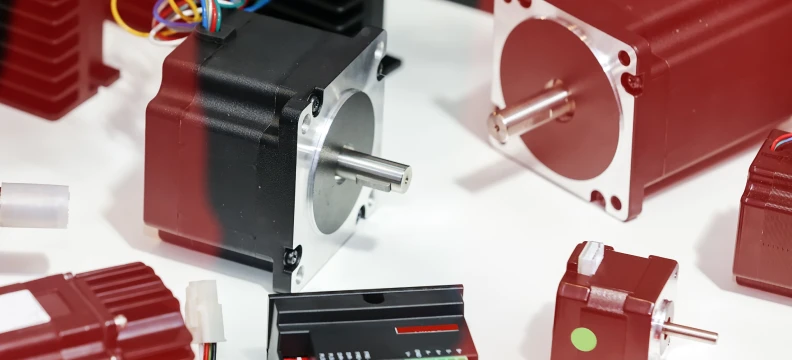
Recommended Motor Configurations by Machine Type
| Machine Type | Axes | Motor Recommendation | Driver Voltage |
| Desktop CNC router (6040) | X, Y, Z | NEMA 23 57BYG250-56 (1.0 N·m) | 24–36V |
| Mid-size CNC router (1200×1200mm) | X, Y, Z | NEMA 23 57BYG250-76 (1.8 N·m) | 36–48V |
| Production CNC router (1300×2500mm) | X, Y, Z | NEMA 34 86BYG250-80 (4.5 N·m) | 48–72V |
| CNC milling machine (aluminum) | X, Y, Z | NEMA 34 86BYG250-118 (8.5 N·m) | 48–72V |
| Laser cutter / engraver | X, Y | NEMA 23 57BYG250-56 (1.0 N·m) | 24–36V |
| Plasma cutter | X, Y, Z | NEMA 23 57BYG250-84 (2.1 N·m) | 36–48V |
| 4th axis rotary | A | NEMA 23 + worm gear reducer | 24–48V |
Open Loop vs. Closed Loop for CNC
Most hobby and semi-professional CNC machines run open-loop stepper systems with excellent results. Open loop is simpler, cheaper, and perfectly adequate when the machine is properly designed and the motors are correctly sized.
Closed loop becomes worth the investment in three situations:
Production machines running unattended. A missed step on a 3-hour unattended job ruins the workpiece and wastes material. Closed loop’s stall detection catches errors immediately.
Machines cutting hard materials with variable loads. Aluminum, brass, and composite materials create load spikes that can exceed the motor’s torque at speed. Closed loop compensates in real time.
Machines where motor downsizing saves significant cost. On a 5-axis machine, replacing five NEMA 34 open-loop motors with five NEMA 23 closed-loop motors can save hundreds of dollars in motor, driver, and power supply costs while improving performance.
Cymotorix offers both open-loop and closed-loop versions of our NEMA 23 and NEMA 34 motors, so you can specify the right level of control for each axis independently.
Driver Selection and Power Supply
The driver converts step/direction signals from your CNC controller into phased current for the motor windings. Key specifications to match:
Output current: must meet or exceed the motor’s rated phase current. A 2.8 A motor needs at least a 3 A driver.
Supply voltage range: higher is generally better for CNC. A 48V driver with a NEMA 23 motor outperforms a 24V driver at every speed above 200 RPM. The driver regulates current regardless of supply voltage, so you cannot overload the motor by using higher voltage.
Microstepping: 1/16 or 1/32 is standard for CNC. Finer microstepping reduces resonance and vibration but does not meaningfully increase positioning accuracy beyond a point. Set microstepping to match your controller’s pulse output frequency capability.
For power supplies, calculate total peak current draw across all axes during simultaneous rapid moves, then add 20%. A 3-axis NEMA 23 system at 2.8 A/phase typically needs a 48V / 10A switching power supply. Do not use unregulated transformers — voltage sag during acceleration causes torque dips.
Thermal Management in CNC Enclosures
Stepper motors get hot during operation — surface temperatures of 60–80°C are normal and within spec. If your motors are enclosed in a cabinet or inside a machine frame, ensure airflow. A small 60 mm fan directed at each motor is cheap insurance against thermal-related failures. Closed-loop motors run significantly cooler due to adaptive current control, which can eliminate the need for active cooling entirely.
Get a Complete CNC Motor Solution from Cymotorix
We supply CNC motor kits (motor + driver + power supply) configured for 2-axis, 3-axis, and 4-axis machines. Our engineering team provides free sizing assistance based on your machine dimensions, drive mechanism, and material requirements. Whether you are building a one-off prototype or scaling to production volumes, Cymotorix delivers consistent quality with competitive OEM pricing.
Contact us today with your machine specifications. We’ll recommend the optimal motor and driver configuration within 24 hours.
Frequently Asked Questions
What size stepper motor do I need for my CNC router?
For desktop routers (under 600 mm travel), NEMA 23 motors with 1.0–1.8 N·m holding torque are typical. For mid-size machines (600–1200 mm travel), NEMA 23 at 1.8–2.5 N·m or NEMA 34 at 3–5 N·m. For large production routers (over 1200 mm travel), NEMA 34 at 5–12 N·m. The exact sizing depends on your drive mechanism (belt, screw, or rack), gantry weight, and target feed rate.
Should I use closed-loop or open-loop stepper motors for CNC?
Open loop works well for hobby and light commercial machines where the motors are properly sized. Closed loop is recommended for production machines running unattended, machines cutting metals or hard composites, and any application where a missed step causes expensive scrap.
What voltage should I run my CNC stepper drivers at?
Higher voltage gives better high-speed torque. For NEMA 23 systems, 36–48V is ideal. For NEMA 34 systems, 48–72V. Avoid running below 24V unless your application is exclusively low-speed.
Can I mix different motor sizes on different CNC axes?
Yes, this is common and recommended. You might use NEMA 34 on X and Y for cutting torque and NEMA 23 on Z where the load is lighter. This optimizes cost and weight without sacrificing performance on the demanding axes.
How do I prevent stepper motor overheating on my CNC machine?
Ensure adequate ventilation around the motors. Use a driver with adjustable idle current reduction — this cuts the holding current by 50–70% when the motor is stationary. Consider closed-loop motors for continuous-duty machines; their adaptive current control reduces heat by 40–60%.
-

Cymotorix
Stepper Motor & Servo Motor ManufacturerCymotorix is a China-based motor manufacturer with 20+ years of experience producing hybrid stepper motors, AC servo motors, and matched drivers for OEM customers worldwide.