
Why Stepper Motors Are the Preferred Motion Source in Medical Devices
Medical and laboratory equipment demands a specific combination of capabilities that stepper motors deliver well: precise positional control from digital signals, high repeatability cycle after cycle, the ability to hold position without consuming excessive power, and operation quiet enough for clinical environments. Unlike servo motors, open-loop stepper motors achieve this without encoders, feedback wiring, or PID tuning — which reduces system complexity, lowers the bill of materials, and eliminates potential failure points.
In regulated medical devices, every additional component in the motion system is another item that must be validated, documented, and qualified for production. The simplicity of a stepper motor system is not just an engineering convenience; it reduces the regulatory burden.
Cymotorix supplies stepper motors to medical device OEMs for infusion pumps, laboratory analyzers, diagnostic imaging equipment, sample handling systems, and rehabilitation devices. This guide explains how we approach motor selection for these applications.
Application-Specific Motor Requirements
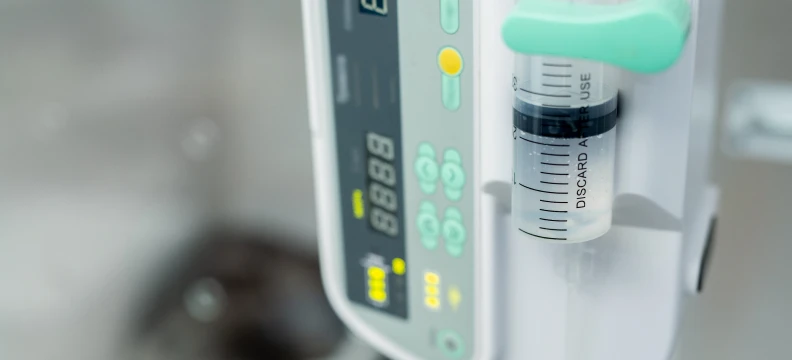
Infusion Pumps and Syringe Drivers
Infusion pumps deliver medication or fluids to patients at precisely controlled flow rates. The stepper motor drives a lead screw that advances the syringe plunger or peristaltic roller at a programmed rate. Accuracy requirements are tight: flow rate deviation must stay within ±5% of the set point, and occlusion (blockage) must be detected promptly.
Motor requirements: low step angle (1.8° or 0.9°) for fine volume resolution, low noise (under 45 dB), low vibration to prevent pulsation in the fluid line, and reliable holding torque to maintain plunger position when the pump is paused. NEMA 14 (35 mm) or small NEMA 17 (42 mm, short body) motors are the standard frame sizes. Current draw should be minimized for battery-operated portable pumps.
Laboratory Sample Handling and Pipetting
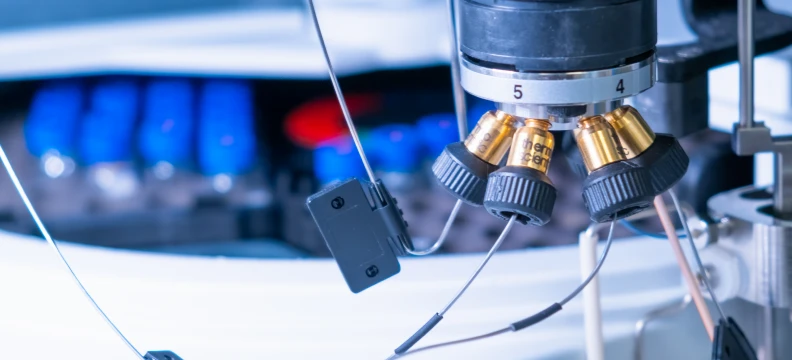
Automated analyzers use stepper motors to position sample trays, move pipetting heads in X/Y/Z, and rotate reagent carousels. These systems run thousands of cycles per day with zero tolerance for positional error — a mispositioned pipette tip means a contaminated or missed sample, which can invalidate an entire batch of test results.
Motor requirements: high repeatability (±0.05 mm or better at the pipette tip), fast settling after short moves, and long service life (10+ million cycles). NEMA 17 motors on ball-screw or belt-drive axes are typical. For rotary carousels, NEMA 23 motors with gear reducers provide the torque needed to index heavy sample trays accurately.
Diagnostic Imaging Equipment
CT scanners, MRI table positioning systems, and X-ray gantries use stepper motors for table translation and tilt. These applications need smooth, jerk-free motion to avoid patient discomfort and imaging artifacts. Motor noise is also a concern in patient-facing equipment.
Motor requirements: NEMA 23 or NEMA 34 depending on table weight and tilt force, microstepping operation (1/16 or 1/32) for smooth motion, and low audible noise. Closed-loop or hybrid servo stepper motors are increasingly specified in imaging applications because their adaptive current control reduces motor heating in the confined space under the patient table.
Ventilators and Respiratory Devices
Stepper motors in ventilators control gas mixing valves, blower speed regulation, and piston-driven volume delivery. Response time and precision are critical: the motor must adjust within milliseconds to match the patient’s breathing pattern. NEMA 17 motors with low rotor inertia provide the fast response needed, and their inherent holding torque holds valve positions without a separate brake mechanism.
Rehabilitation and Assistive Devices
Robotic rehabilitation arms, powered orthotic joints, and motorized wheelchairs use stepper motors for controlled, repeatable motion that can be precisely programmed by therapists. Safety is paramount: the motor must not produce unexpected movements, and it must hold position firmly when commanded to stop. Stepper motors’ natural detent torque provides a mechanical safety lock that servo motors do not offer.
Motor Selection Criteria for Medical Applications
| Criterion | Typical Requirement | Cymotorix Solution |
| Noise | < 45 dB at operating speed | Low-vibration hybrid stepper design, microstepping drivers |
| Positional Accuracy | ±0.05 mm or better | 1.8°/0.9° step angle, 1/32 microstepping available |
| Repeatability | ±0.02 mm | Precision-machined rotor/stator, tight air gap tolerance |
| Service Life | 10M+ cycles | Ball bearings rated for continuous duty, Class B insulation |
| Operating Temperature | -20°C to +50°C | Standard across all Cymotorix stepper motors |
| Certification | CE, RoHS minimum | CE and RoHS certified; material traceability available |
| Customization | OEM shaft, connector, winding | Custom shafts, lead wires, connectors, winding voltages |
Open Loop vs. Closed Loop in Medical Devices
Most medical stepper motor applications run open-loop. This is deliberate: fewer components means fewer failure points, simpler validation, and easier regulatory clearance. An open-loop stepper motor driven within its rated specifications will not miss steps, making encoder feedback unnecessary in well-designed systems.
Closed-loop control is specified when the application cannot tolerate any risk of step loss, regardless of how small:
Drug delivery systems: where a missed step means incorrect dosage. Closed-loop provides positive confirmation that the motor reached its target position.
Automated analyzers handling irreplaceable samples: where a positioning error means losing a sample that cannot be re-collected. The stall alarm provides the system with an integrity check.
Patient-contact devices: where unexpected movement could cause injury. Closed-loop with stall detection adds a safety layer that can trigger an immediate stop.
OEM Customization for Medical Device Manufacturers
Medical OEMs rarely use off-the-shelf motors without modification. Common customization requests we handle include:
Custom shaft dimensions: specific diameter, flat depth, length, and thread for direct coupling to lead screws, gears, or encoders without adapters.
Lead wire and connector: pre-terminated cables with specific connector types (JST, Molex, custom) and lengths, color-coded to the OEM’s wiring standard.
Winding optimization: custom resistance and inductance values to match the OEM’s driver voltage and current architecture, optimizing for either minimum heat or maximum torque.
Labeling and traceability: laser-etched part numbers, date codes, and batch tracking for regulatory compliance.
Special coatings or materials: conformal coating on windings for moisture resistance, food-grade lubricant on bearings for devices in sterile environments.
Minimum order quantities for custom medical motors are negotiable depending on modification complexity. We support prototype quantities for device development and scale to production volumes without re-qualification.
Partner with Cymotorix for Medical Motion Solutions
Cymotorix has supplied stepper motors to medical device manufacturers for over 15 years. Our production facility operates under strict quality management, and every motor ships with individual test data. We understand the documentation, traceability, and consistency requirements of the medical industry.
Contact our medical applications team to discuss your device’s motion requirements. We provide engineering samples within 2 weeks and production pricing within 48 hours.
Frequently Asked Questions
What type of stepper motor is used in infusion pumps?
Most infusion pumps use NEMA 14 (35 mm) or small NEMA 17 (42 mm, 28–34 mm body length) 2-phase hybrid stepper motors with 1.8° or 0.9° step angle. Low noise and low current draw are priorities. The motor typically drives a lead screw that advances the syringe plunger or a cam that compresses peristaltic tubing.
Do medical stepper motors need to be closed-loop?
Not always. Most medical devices run stepper motors open-loop when the motor is properly sized for the load. Closed-loop is specified for applications where step loss would directly affect patient safety (drug dosing, sample handling) or where positive position confirmation is a regulatory requirement.
Can Cymotorix provide custom stepper motors for medical OEMs?
Yes. We offer custom shaft configurations, connector types, lead wire lengths, winding specifications, and labeling. We support prototype quantities for R&D and scale to volume production. All products are CE and RoHS certified, with material traceability available on request.
What certifications do Cymotorix stepper motors carry?
All Cymotorix stepper motors carry CE and RoHS certification. For medical device applications, we provide material declarations and batch traceability documentation. The motor is a component within the OEM’s device; the device-level medical certifications (FDA, MDR, etc.) are the responsibility of the device manufacturer.
How quiet are stepper motors for medical equipment?
With microstepping drivers (1/16 or finer), Cymotorix stepper motors operate below 45 dB at typical medical equipment speeds. For even quieter operation, TMC-series drivers with StealthChop mode can bring noise below 35 dB, making the motor virtually inaudible in a clinical environment.
-

Cymotorix
Stepper Motor & Servo Motor ManufacturerCymotorix is a China-based motor manufacturer with 20+ years of experience producing hybrid stepper motors, AC servo motors, and matched drivers for OEM customers worldwide.